
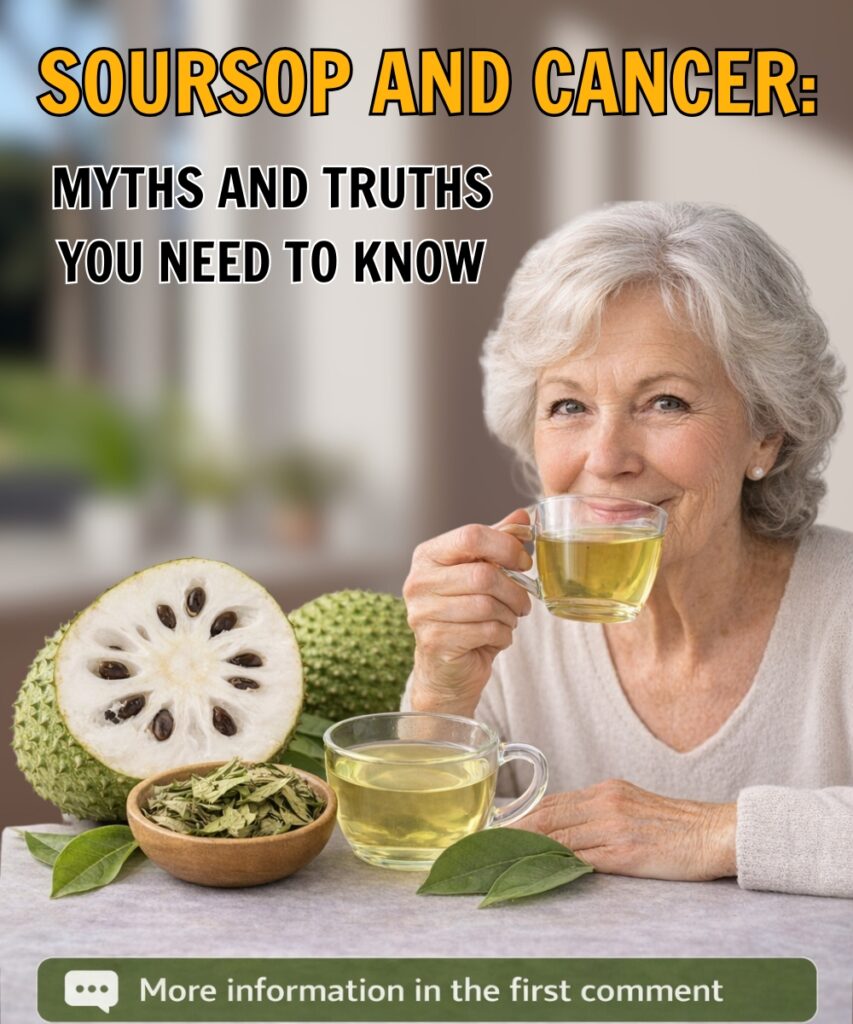
Soursop and Cancer: Myths and What Science Says
Thousands of posts circulating online claim that soursop “cures cancer.” This idea is repeated so often that many people take it as fact, when in reality the issue is more complex. If you are looking for reliable information about soursop and cancer, here you will find a clear explanation: what has been studied, what has NOT been proven in humans, and what the risks are of believing in absolute promises.
Important notice: This content is for informational purposes only and does not replace medical evaluation. In cancer, any change in treatment should be discussed with an oncologist.
What is soursop and why is it linked to cancer?
Soursop (Annona muricata), also known as graviola or graviola, is a tropical fruit consumed as food. In addition to the fruit, in some cultures, the leaves and stems are used in traditional infusions. The link to cancer arises because plant compounds (such as acetogenins) have been identified that, in laboratory studies, show biological activity on certain cells. The problem arises when “preliminary scientific interest” is transformed into a “proven cure,” something that is not currently supported by solid clinical evidence in humans. Memorial Sloan Kettering Cancer Center+1
Before believing or sharing: what kind of studies exist
To understand why there is so much confusion, it is necessary to distinguish between levels of evidence:
In vitro (laboratory): tested on cells, not on people.
In animals: helps to explore mechanisms, but does not confirm efficacy in humans.

Clinical trials in humans: these are the ones that allow us to conclude if something works, at what dose, for whom, and with what risks.
Most popular claims about soursop and cancer are based primarily on laboratory studies, not on conclusive clinical trials. Cancer Research UK+1
Common Myths About Soursop and Cancer
Myth 1: “Soursop cures cancer”
To date, leading organizations and institutions indicate that there is insufficient reliable evidence to claim that soursop treats or cures cancer in humans. Cancer Research UK+1
Myth 2: “It’s more effective than chemotherapy”
Chemotherapy (and other cancer therapies) is based on decades of clinical research. In contrast, soursop does not have that level of human evidence to compare it to, or to replace, other treatments. ASCO Post+1
Myth 3: “Leaf tea eliminates tumors”
There is no robust clinical evidence demonstrating that an infusion of soursop leaves eliminates tumors. Many sources confuse in vitro results with real effects in the human body, where absorption, metabolism, dosage, and safety all play a role. Memorial Sloan Kettering Cancer Center+1
Myth 4: “Since it’s natural, it can’t hurt.”
“Natural” does not mean “harmless.” In fact, in the case of soursop, potential neurological risks related to compounds such as annonacin (an acetogenin) and the frequent/prolonged consumption of Annonaceae products in certain contexts have been investigated. PubMed+1
Myth 5: “It works for any type of cancer.”
Cancer is not a single disease. There are multiple types, subtypes, and treatments. A universal claim (“it works for everything”) is, by definition, a red flag.
Important truths about soursop and cancer
Truth 1: There are interesting compounds, but the leap to humans is not proven.
Several reviews and publications describe anti-cellular activity in the laboratory and in experimental models, which may be useful for research, but does not equate to therapeutic efficacy in humans. Even reviews of its use in patients point out significant limitations and the need for caution due to methodological quality. mjpharm.org+1

Fact 2: As a fruit, it can be part of a diet (in moderation). Consumed as food, soursop can be part of a varied diet. The focus here is nutritional, not “anti-cancer.”
Fact 3: Complement, not substitute. If a person with cancer wishes to use traditional remedies to support their well-being (for example, for hydration, appetite, or routine), it is wise to discuss this with their medical team and avoid abandoning proven treatments. Cancer Research UK+1
Risks and precautions: what many don’t mention. One of the most overlooked points on social media is safety. A possible link between high consumption of Annonaceae products (including infusions) and atypical parkinsonism has been studied in certain populations, in addition to experimental evidence of neurotoxicity from compounds such as annonacin. This does not mean that “eating soursop causes Parkinson’s,” but it does mean that frequent and concentrated use (leaves, extracts, capsules) warrants caution. PubMed+2
Especially avoid:
Concentrated capsules/extracts of dubious origin.
“Protocols” of daily consumption for months without supervision.
Mixing supplements with treatments without informing your oncologist.
