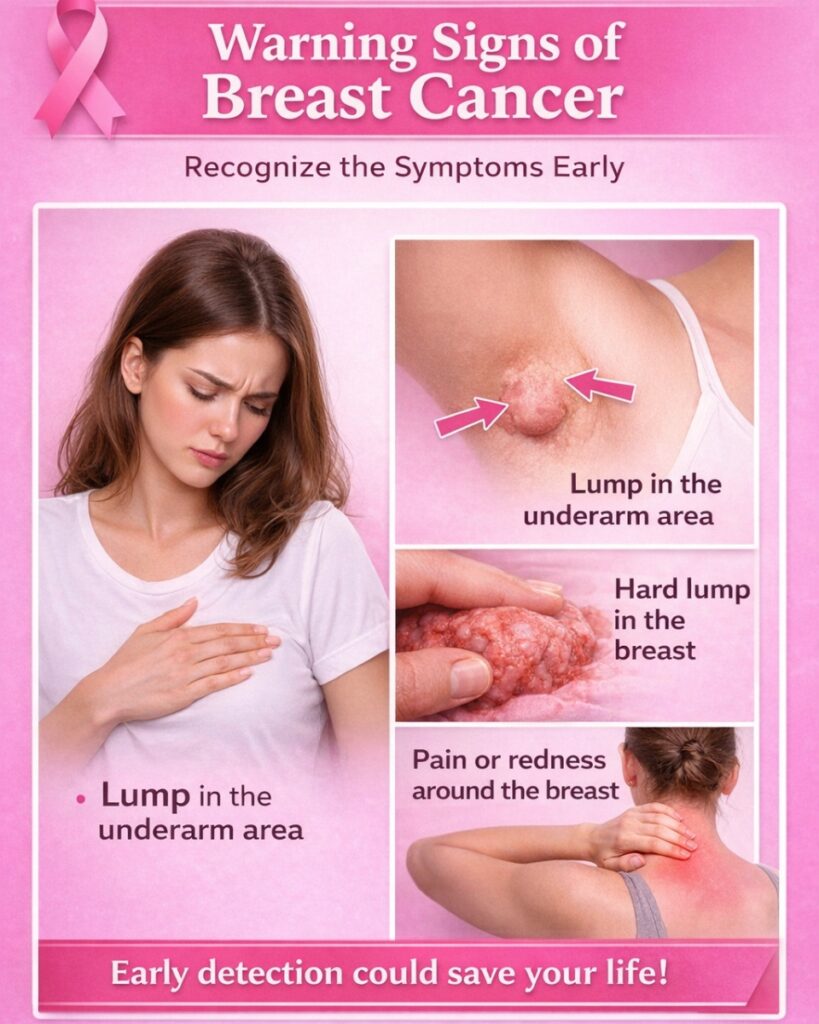
Breast health is something many people think about only occasionally. Small changes in the breast are often dismissed as hormonal fluctuations, stress, or temporary irritation. Life gets busy, and it’s easy to assume that unusual symptoms will simply disappear. However, in some situations, these subtle changes may represent early warning signs of breast cancer. Ignoring them could allow a condition that is highly treatable in its early stages to progress into a more serious health concern. The encouraging news is that early detection dramatically improves outcomes. Awareness and timely medical evaluation can truly save lives. In this article, we explore 10 potential warning signs of breast cancer that both women and men should be aware of, along with why early detection is so important. Why Early Detection Matters Breast cancer often begins silently, developing within the milk ducts or lobules without obvious symptoms. When the disease is detected early—before spreading beyond the breast—the five-year survival rate can reach about 99%, according to the American Cancer Society. When cancer spreads to nearby lymph nodes or distant organs, survival rates decline significantly. Numerous studies consistently show that routine screening and attention to physical changes lead to earlier diagnosis and more effective, less aggressive treatment. In the United States alone, estimates suggest that in 2025 approximately 316,950 new invasive breast cancer cases will be diagnosed in women, along with about 2,800 cases in men. At the same time, more than 4 million survivors are living today—an encouraging reminder of how powerful early detection can be. Unfortunately, delays often occur because people hope symptoms will disappear on their own. Knowledge helps change that pattern. 10 Possible Warning Signs of Breast Cancer 1. Swollen Lymph Nodes Near the Armpit or Collarbone Enlarged lymph nodes can sometimes indicate that cancer cells have spread beyond the breast. Possible signs include: Firm swelling under the arm A lump near the collarbone Persistent enlargement that does not go away Any unexplained lymph node swelling should be evaluated by a healthcare professional. 2. Unusual Nipple Discharge Any nipple discharge unrelated to breastfeeding deserves medical attention, especially if it appears suddenly. Examples include: Bloody discharge (most concerning) Clear or colored fluid Spontaneous leakage without squeezing Although many causes are benign, a doctor should always assess this symptom. 3. Redness, Scaling, or Thickening of the Nipple or Areola Persistent redness or flaking around the nipple may be associated with Paget’s disease of the breast, a rare condition that is often linked to underlying breast cancer. Signs may include: Skin irritation around the nipple Crusting or peeling skin Persistent itching or burning sensation 4. Nipple Retraction or Turning Inward If the nipple suddenly pulls inward after previously pointing outward, it may indicate underlying tissue changes. Warning indicators: Sudden inversion of the nipple Changes affecting only one breast Associated lump or skin change nearby 5. Unexplained Swelling in the Breast or Underarm Breast cancer does not always appear as a distinct lump. Sometimes it causes generalized swelling in the breast or nearby lymph nodes. This may include: Sudden enlargement of one breast Swelling in the armpit area Tightness or fullness in the breast 6. Persistent Breast or Nipple Pain Most breast pain is benign and related to hormonal changes. However, persistent, localized pain that does not follow the menstrual cycle should be evaluated. Pay attention if: Pain lasts several weeks It occurs in one specific spot It is not linked to hormonal changes 7. Hard Lumps or Thickened Areas A firm lump under the skin is one of the most recognized warning signs. Cancerous lumps are often: Hard or irregular in shape Fixed in place Usually painless