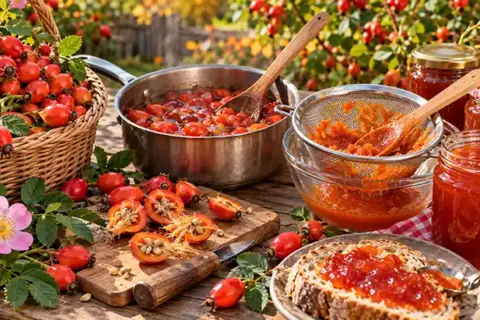
Homemade Hawthorn Berry Wine – How to Turn Autumn Haws Into a Rich, Fruity Country Wine
Every fall, hawthorn trees become covered with clusters of small red fruits known as haws. Birds certainly notice them, but many people walk straight past without realizing those bright berries have a long history of culinary use.
Hawthorn berries can be turned into jellies, sauces, syrups, infusions—and a particularly interesting traditional project: homemade hawthorn wine.
Fresh haws aren’t intensely juicy like grapes or blackberries. Their flesh can be dry and mealy, with a mild apple-like tartness and considerable variation from tree to tree. Fermentation transforms them.
With water, sugar, wine yeast, careful preparation, and enough aging time, hawthorn berries can produce a beautiful amber-red to ruby country wine with delicate fruit, floral, apple-like, and sometimes lightly earthy notes.
The recipe isn’t difficult, but hawthorn wine rewards patience. It’s also important to identify the fruit correctly and avoid crushing the hard seeds inside.
Here’s how to make a small batch from beginning to end.
What Are Hawthorn Berries?
Hawthorns belong to the genus Crataegus, a large group of shrubs and small trees in the rose family.
The small fruits are commonly called haws.
Depending on the species and cultivar, ripe fruits may be:
- Bright red
- Deep red
- Orange-red
- Burgundy
- Occasionally much darker
Their flavor varies considerably.
Some are relatively fruity and pleasant, while others are dry, bland, mealy, or strongly astringent.
This variation is one reason homemade hawthorn wine can taste slightly different from one harvest to another.
When Are Hawthorn Berries Ready to Harvest?
Haws generally ripen from late summer through fall, depending on species and climate.
For wine, look for fruit that has developed its mature color and is beginning to soften slightly.
You want ripe berries—not hard, pale, immature ones.
Good haws should generally be:
- Fully colored
- Plump
- Free from mold
- Free from rot
- Reasonably firm but mature
Taste can help if you’ve positively identified an edible hawthorn.
A ripe haw should taste noticeably less green and harsh than an immature one.
Do You Need to Wait for the First Frost?
No.
As with sloes and several other traditional autumn fruits, you’ll sometimes hear that hawthorn berries should only be gathered after frost.
Cold weather can soften fruit, but natural frost isn’t essential.
If your berries are ripe, you can harvest them before birds or bad weather take the crop.
Then simply freeze them at home.
Freezing has another advantage: it helps break down the fruit’s structure, making juice, color, and flavor easier to extract.
Important: Correct Identification Comes First
Never make wine from a wild fruit you haven’t confidently identified.
Many hawthorns have:
- Thorny branches
- Lobed or toothed leaves
- White spring flowers
- Clusters of red autumn fruit
But those features alone shouldn’t substitute for proper identification.
If you’re uncertain about a tree or shrub, don’t use its fruit.
Also avoid harvesting from areas likely to have been treated with unsuitable pesticides or exposed to heavy roadside contamination.
Hawthorn Seeds: Don’t Crush Them
This is an important preparation rule.
Hawthorn belongs to the rose family, and its seeds contain cyanogenic glycosides.
The practical rule for home wine is straightforward:
Use the flesh and skins, but don’t grind, pulverize, or deliberately break the seeds.
Lightly crushing ripe fruit to open it is useful.
Smashing the seeds into fragments isn’t.
The same principle applies when straining the fermented fruit later: don’t aggressively grind the remaining solids in an attempt to extract every last drop.
What Does Hawthorn Wine Taste Like?
Hawthorn wine doesn’t taste like grape wine with a few berries added.
Its character is more subtle.
Depending on the hawthorn, fermentation, sweetness, and aging, you may notice flavors reminiscent of:
- Apple
- Red berries
- Rose hips
- Dried fruit
- Light floral notes
- Honey
- Herbs
- Gentle earthiness
Young wine may taste somewhat sharp or rustic.
A few months of maturation can make a surprisingly large difference.
Homemade Hawthorn Berry Wine Recipe
This recipe makes approximately 1 gallon (3.8 liters) of country wine before losses from fruit solids, sediment, and racking.
Ingredients
- 4 lb (1.8 kg) ripe hawthorn berries
- 2½–3 lb (1.1–1.35 kg) granulated sugar, adjusted according to hydrometer readings
- Enough water to produce approximately 1 gallon (3.8 liters) of must
- 1 packet wine yeast suitable for fruit or white/rosé-style wines
- 1 teaspoon yeast nutrient, or according to manufacturer instructions
- Pectic enzyme, according to package instructions
Optional
- ½–1 lb chopped apples
- A small amount of lemon or acid blend if testing shows additional acidity is needed
- A small quantity of tannin only if necessary
Don’t automatically add large amounts of acid or tannin. Hawthorn species vary, so it’s better to evaluate the fruit first.
Equipment
For a small batch you’ll need:
- Food-grade primary fermenter
- Large nonreactive saucepan
- Fermentation bag or fine strainer
- 1-gallon demijohn/carboy
- Airlock and stopper
- Hydrometer
- Siphon
- Sanitizer suitable for winemaking
- Funnel
- Wine bottles
- Appropriate closures
If you’re serious about making fruit wine, buy a hydrometer.
It removes a tremendous amount of guesswork from fermentation.
Step 1: Sort the Hawthorn Berries
Spread the berries across a tray or table.
Remove:
- Leaves
- Twigs
- Stems
- Insects
- Moldy fruit
- Rotten fruit
- Badly damaged berries
- Obviously immature fruit
A few cosmetic blemishes aren’t necessarily a problem.
Mold and decay are.
Start with the best fruit possible.
Step 2: Wash Them Thoroughly
Rinse the berries under cool running water.
Drain them well.
You don’t need to soak them for hours.
The goal is simply to remove dirt, dust, insects, and debris before fermentation.
Step 3: Freeze the Berries
Place the cleaned berries in freezer-safe bags or containers and freeze them completely.
Leave them frozen overnight or longer.
When you’re ready to begin the wine, thaw them.
You’ll notice that thawed fruit becomes softer.
This makes extraction easier.
Freezing is particularly useful with hawthorn because haws aren’t especially juicy fruits.
Step 4: Lightly Crush the Haws
Place the thawed fruit in a sanitized fermentation bag inside your primary fermenter.
Using a sanitized potato masher or similar utensil, lightly crush the berries.
The objective is to:
Break skins and soften flesh without pulverizing seeds.
Don’t put whole haws through a high-powered blender.
You don’t need hawthorn puree.
You need opened fruit from which water and fermentation can extract flavor.
Step 5: Make the Sugar Syrup
Heat part of the water in a large saucepan.
Add most of your sugar.
Stir until completely dissolved.
You don’t need to boil the sugar for an extended period.
Pour the hot sugar solution over the crushed fruit.
Then add additional water as needed.
The warm liquid helps extract color and flavor from the haws.
Step 6: Don’t Guess the Sugar Level
Old country-wine recipes often say something like:
“Add three pounds of sugar.”
That can work, but it isn’t particularly precise.
Fruit naturally contains sugar, and the amount varies between harvests.
Use a hydrometer to measure the specific gravity of the must.
For many table-style fruit wines, a starting gravity somewhere around 1.085–1.100 may be reasonable, depending on your intended final alcohol level and style.
For example, if you begin around 1.090 and fermentation finishes near 1.000, the resulting wine will be roughly around 12% alcohol by volume.
That’s only an approximation; actual ABV depends on starting and final readings.
Step 7: Let Everything Cool
Before adding yeast, allow the must to cool to a suitable fermentation temperature.
Never sprinkle wine yeast directly into near-boiling fruit.
You’ll kill it.
Different yeast strains have different preferred temperature ranges, so follow the manufacturer’s instructions.
Step 8: Add Pectic Enzyme
Once the must has cooled, add pectic enzyme according to the product directions.
Hawthorn fruit contains pectin.
Pectic enzyme can help:
- Break down fruit structure
- Improve juice extraction
- Improve color extraction
- Reduce pectin haze
- Help the finished wine clear
It’s especially useful with fruits that contain substantial pectin.
Step 9: Check Acidity Before Adding Lemon
Many traditional fruit-wine recipes automatically add one or two lemons.
That’s not always necessary.
Hawthorn species differ significantly in acidity.
Some fruit is tart.
Other fruit is surprisingly mild.
If you have the equipment, measure pH and titratable acidity.
If you don’t, be conservative.
You can adjust an under-acid wine later more easily than fixing one that you’ve made painfully sour.
If your must tastes very flat, a modest amount of acid adjustment may improve it.
Don’t automatically add lemon simply because an old recipe says every fruit wine needs one.
Step 10: Consider Tannin Carefully
Tannin gives wine structure and contributes a drying sensation.
Hawthorn can already provide some tannin.
Therefore, don’t automatically add:
- Strong black tea
- Large amounts of powdered wine tannin
- Other highly tannic fruit
Taste and evaluate first.
The goal isn’t to create the driest possible sensation in your mouth.
It’s balance.
Step 11: Add Yeast Nutrient
Fruit must doesn’t always provide wine yeast with an ideal nutrient profile.
Add an appropriate yeast nutrient according to the manufacturer’s instructions.
This can support healthy fermentation and reduce the likelihood of sluggish yeast.
Don’t assume twice as much nutrient produces twice as good a wine.
Follow the recommended dose.
Step 12: Add Wine Yeast
Once the must is cool and ready, add your chosen wine yeast.
Wine yeast is preferable to bread yeast because it offers more predictable:
- Alcohol tolerance
- Fermentation behavior
- Flavor
- Attenuation
A yeast intended for fruit wines, rosé, or lighter red wines can work well.
Some yeast strains emphasize fresh fruit aromas.
Others ferment very dry and neutral.
The choice becomes part of your recipe.
Step 13: Begin Primary Fermentation
Cover the primary fermenter appropriately and keep it within your yeast’s recommended temperature range.
Fermentation usually becomes obvious within roughly 12–48 hours.
Signs can include:
- Bubbling
- Foam
- Fruity fermentation aromas
- Fruit floating upward
- Increased activity at the surface
Don’t worry if it doesn’t erupt like a volcano.
Healthy fermentation isn’t always dramatic.
Step 14: Keep the Fruit Wet
Fruit pieces may rise to the surface during active fermentation and form a cap.
Using a sanitized spoon or paddle, gently push the floating fruit back into the liquid once or twice daily.
This:
- Improves extraction
- Keeps fruit from drying on the surface
- Helps reduce opportunities for spoilage organisms
Be clean and gentle.
You don’t need to vigorously whip air into the fermenter.
Step 15: Monitor the Gravity
Take hydrometer readings as fermentation progresses.
Specific gravity should gradually fall as yeast converts sugar into alcohol and carbon dioxide.
This gives you actual information about fermentation.
Bubbles alone don’t.
An airlock can bubble because of temperature changes.
It can stop bubbling because of a poor seal.
The hydrometer tells you what’s happening to the sugar.
Step 16: Remove the Fruit
After roughly 5–7 days of active primary fermentation, depending on fermentation progress, remove the hawthorn solids.
Lift the fermentation bag and allow it to drain.
You can press gently.
Don’t aggressively crush the remaining seeds.
Discard the spent fruit appropriately.
Step 17: Transfer to Secondary Fermentation
Siphon the young wine into a sanitized demijohn.
At this stage, leave much less headspace than you did during vigorous primary fermentation.
Attach an airlock.
The wine will continue fermenting more slowly.
Over the following weeks, you’ll see sediment accumulate at the bottom.
Step 18: Let Fermentation Finish
Secondary fermentation may take several weeks or longer.
Temperature, yeast strain, original sugar concentration, nutrient availability, and fruit chemistry all influence fermentation speed.
Don’t set a rigid deadline.
Your wine doesn’t know what day your recipe says it should finish.
Watch the gravity.
Step 19: Rack the Wine
Once substantial sediment has accumulated, siphon the wine into another sanitized vessel.
Leave the sediment behind.
This is racking.
Try not to splash the wine.
After vigorous fermentation has ended, excessive oxygen becomes increasingly undesirable because it can contribute to oxidation.
Keep the siphon outlet beneath the surface of the receiving wine whenever practical.
What Is the Sediment?
The material at the bottom is commonly called lees.
It contains:
- Spent yeast
- Tiny fruit particles
- Pectin
- Other solids
A little fine sediment isn’t an emergency.
But you don’t generally want rustic fruit wine sitting indefinitely on a thick layer of coarse fruit sediment.
Rack when appropriate.
Step 20: Let the Wine Clear
Hawthorn wine may initially be cloudy.
Give it time.
Some batches clear relatively quickly.
Others need several months.
Pectic enzyme helps if pectin is contributing to haze.
Additional racking can also help as sediment continues settling.
Patience is usually preferable to repeatedly adding unnecessary clarification products.
How Do You Know Fermentation Is Finished?
Don’t rely solely on the airlock.
Instead:
- Take a hydrometer reading.
- Wait several days.
- Take another reading.
If the readings remain stable and the wine is at an appropriate final gravity, fermentation is much more likely to have finished.
A dry wine commonly finishes around or slightly below 1.000, although the precise reading varies.
Never Bottle Wine That’s Still Fermenting
Residual fermentation inside a sealed bottle creates carbon dioxide.
If that gas can’t escape, pressure builds.
Possible consequences include:
- Pushed corks
- Leaking bottles
- Broken bottles
This isn’t simply a quality issue.
It can become a physical safety issue.
Verify fermentation has finished before bottling still wine.
Step 21: Taste the Young Wine
Once fermentation is finished and the wine has begun clearing, taste a small sample.
Young hawthorn wine may seem:
- Sharp
- Thin
- Dry
- Slightly bitter
- Tannic
- Rustic
Don’t immediately assume the batch has failed.
Young fruit wine frequently needs time for its flavors to integrate.
Step 22: Let It Mature
Hawthorn wine benefits from aging.
Allow at least:
3–6 months
For a more mature result:
6–12 months
A particularly structured batch may continue developing beyond a year.
During maturation:
- Harshness can soften
- Aromas can integrate
- Tannins may become less aggressive
- Fruit character can become more rounded
If you’ve never aged homemade fruit wine before, save bottles to taste at different intervals.
Try one at six months and another at twelve.
The comparison is part of the fun.
Dry or Sweet Hawthorn Wine?
Either style can work.
Dry Hawthorn Wine
Allow nearly all fermentable sugar to ferment.
This produces a more wine-like, less obviously fruity drink.
Off-Dry Hawthorn Wine
A touch of sweetness can emphasize hawthorn’s fruit character and soften acidity.
Sweet Hawthorn Wine
A sweeter version can become rich and dessert-like.
But don’t simply add sugar to finished wine and immediately bottle it.
Be Careful When Backsweetening
If living yeast remains in the wine and you add sugar, fermentation may restart.
Inside sealed bottles, that’s potentially dangerous.
If you want to backsweeten a finished wine, use a recognized stabilization method appropriate for home winemaking before adding fermentable sugar.
Home winemakers commonly use appropriate amounts of potassium metabisulfite and potassium sorbate when stabilizing still wine before backsweetening.
Follow the manufacturer’s directions carefully.
Alternatively, leave the wine dry.
How Strong Will Hawthorn Wine Be?
Alcohol depends on starting and finishing gravity.
For example:
Starting gravity: 1.092
Final gravity: 0.998
A common rough calculation is:
(1.092 − 0.998) × 131.25
That gives approximately:
12.3% ABV
This is why a hydrometer is so useful.
Instead of saying, “I added three pounds of sugar, so I think it’s strong,” you can actually estimate the alcohol level.
Are Hawthorn Berries Rich in Vitamins?
Fresh hawthorn fruits contain vitamin C and a variety of polyphenolic plant compounds, including flavonoids and procyanidins.
However, there’s an important difference between fresh hawthorn fruit and finished hawthorn wine.
Vitamin C is sensitive to:
- Heat
- Oxygen
- Processing
- Fermentation
- Long storage
So you shouldn’t assume a glass of year-old hawthorn wine contains the same amount of vitamin C as freshly harvested haws.
The fruit has an interesting nutritional composition.
The finished wine should be regarded primarily as an alcoholic fermented beverage, not a vitamin supplement.
Is Hawthorn Wine a Heart Remedy?
Hawthorn has a long history of traditional herbal use, and standardized hawthorn preparations have been studied for certain cardiovascular applications.
That does not mean homemade hawthorn wine should be treated as medicine.
The concentration of active compounds in homemade wine isn’t standardized, and alcohol introduces its own health considerations.
People taking heart or blood-pressure medications, or anyone managing cardiovascular disease, shouldn’t use homemade hawthorn preparations as a substitute for medical treatment.
Make hawthorn wine because you enjoy traditional fermentation and its flavor—not because you’re trying to treat an illness.
Hawthorn & Apple Wine
Apple is probably one of the easiest fruits to combine with hawthorn.
Both belong to the rose family, and their flavors work naturally together.
Apple can contribute:
- Juice
- Fermentable sugar
- Fresh acidity
- Familiar fruit character
- Body
Try using approximately:
3 lb hawthorn berries + 1 lb apples
for a one-gallon experimental batch.
Use ripe aromatic apples.
Hawthorn & Blackberry Wine
Blackberries give hawthorn wine deeper berry character and darker color.
Try:
- 3 lb haws
- 1 lb blackberries
The blackberry can make a subtle hawthorn wine taste fuller and fruitier.
This is a particularly nice combination if your haws have relatively mild flavor.
Hawthorn & Rose Hip Wine
These two autumn fruits are natural companions.
Rose hips contribute:
- Fruity tartness
- Color
- Floral complexity
Both fruits require careful preparation because of their seeds and internal structures.
This blend can produce a distinctly autumnal country wine.
Hawthorn & Elderberry Wine
If you want deeper color, elderberries can transform hawthorn wine.
A small proportion of elderberry adds:
- Dark purple color
- Stronger berry aroma
- Additional structure
Don’t overdo it.
Elderberry can easily dominate hawthorn’s subtler character.
Think of elderberry as an accent rather than automatically making the blend 50/50.
Hawthorn & Sloe Wine
This can create a much more structured drink.
Sloes contribute strong:
- Acidity
- Tannin
- Dark-fruit character
Because both fruits can be somewhat astringent, use sloes conservatively unless you’re intentionally making a robust wine that you’ll age for a long time.
Should You Add Raisins?
Many traditional country-wine recipes add raisins.
They can contribute:
- Fermentable sugar
- Body
- Dried-fruit flavor
But raisins aren’t essential.
Modern yeast nutrient and proper sugar measurements allow you to make excellent fruit wine without them.
Add raisins because you want their flavor—not because you think wine can’t ferment without them.
Should You Add Black Tea?
Black tea is another traditional ingredient used to add tannin.
Again, don’t automatically add it.
Some hawthorn berries already provide enough structure.
Taste the must and consider the fruit you’re using.
If you’re combining hawthorn with highly tannic sloes or elderberries, additional tea may be completely unnecessary.
Can You Add Spices?
Yes, but be conservative.
Hawthorn can pair with:
- Cinnamon
- Vanilla
- Orange peel
- Clove
- Ginger
The problem is that wine ages.
A clove floating in juice for a few minutes is one thing.
Strong spice extraction followed by months of maturation is another.
For your first batch, I’d make the wine without spices.
Learn what hawthorn actually tastes like.
You can always experiment later—or gently mull a bottle when serving it during winter.
10 Tips for Better Hawthorn Wine
1. Use Fully Ripe Fruit
Immature haws generally contribute less flavor and more harshness.
2. Freeze Them First
It makes extracting flavor from the dry flesh easier.
3. Don’t Crush the Seeds
Break the flesh and skins, not the hard kernels.
4. Sanitize Everything
Once your must has cooled, anything touching it should be properly sanitized.
5. Use Wine Yeast
You’ll get much more predictable results.
6. Measure Sugar With a Hydrometer
Don’t rely entirely on a fixed recipe.
7. Don’t Automatically Add Acid
Different hawthorns have different acidity levels.
8. Use Pectic Enzyme
Hawthorn can produce pectin haze.
9. Minimize Oxygen After Primary Fermentation
Siphon carefully and keep secondary vessels appropriately filled.
10. Give the Wine Time
A mediocre young wine can become a surprisingly pleasant mature wine.
7 Common Hawthorn Wine Mistakes
1. Using Poorly Identified Wild Fruit
Correct identification is essential.
2. Grinding the Seeds
There’s no reason to pulverize them.
3. Adding Too Much Sugar
High alcohol doesn’t automatically mean better flavor.
4. Automatically Adding Lemon and Tannin
Hawthorn fruit varies. Adjust according to the actual batch.
5. Ignoring Sanitation
Fruit wine spends months developing. Contamination can ruin all that work.
6. Bottling When the Airlock Stops
Check stable hydrometer readings instead.
7. Expecting It to Taste Finished After a Few Weeks
Give hawthorn wine time to mature.
Troubleshooting: My Hawthorn Wine Tastes Too Thin
This can happen because haws themselves aren’t particularly juicy.
Possible approaches for a future batch include:
- Using more fruit
- Adding apple
- Adding a small amount of blackberry
- Starting with less dilution
- Allowing more maturation time
Don’t automatically solve thin wine by adding enormous quantities of sugar.
That raises alcohol without necessarily adding body.
Troubleshooting: It’s Too Tart
First, let it age.
Young fruit wine often tastes sharper than mature wine.
If the finished, mature wine remains too acidic, a small amount of sweetness can make acidity seem much softer.
Blending with a softer finished wine is another possibility.
Don’t make major corrections without measurements if you’re using chemical deacidification methods.
Troubleshooting: It’s Too Sweet
If fermentation genuinely finished with substantial residual sugar, the yeast may have stopped because of:
- Alcohol tolerance
- Nutrient problems
- Temperature
- pH
- Other fermentation stress
Measure the gravity.
Don’t simply add more yeast without understanding why fermentation stopped.
Troubleshooting: It’s Cloudy
Give it time.
Cloudiness may come from:
- Yeast
- Fruit solids
- Pectin
- Continuing fermentation
Pectic enzyme, proper racking, and patience solve many clarity problems.
Don’t rush to bottle cloudy, unstable wine simply because the recipe’s estimated date has arrived.
A Simple Hawthorn Wine Timeline
HARVEST
Pick fully ripe haws, sort and wash them.
FREEZE
Freeze overnight or longer.
DAY 1
Thaw and lightly crush the fruit.
Prepare sugar syrup, build the must, cool it, take a hydrometer reading, add the appropriate ingredients and pitch the yeast.
DAYS 2–7
Active primary fermentation.
Keep floating fruit wet and monitor fermentation.
AROUND DAYS 5–7
Remove fruit when fermentation has progressed appropriately and transfer to a demijohn.
FOLLOWING WEEKS
Allow secondary fermentation to continue under airlock.
AFTER FERMENTATION
Rack away from accumulated sediment.
FOLLOWING MONTHS
Allow the wine to clear and mature.
Rack again if significant sediment develops.
3–6 MONTHS
Begin evaluating the wine.
6–12 MONTHS
Taste mature bottles and compare them with younger samples.
Remember:
These are guidelines, not deadlines.
Specific gravity and the condition of the wine are more important than the date on the calendar.
How to Store Finished Hawthorn Wine
Keep bottles somewhere:
- Cool
- Dark
- Stable
- Away from direct sunlight
- Away from major temperature swings
Label every bottle with the batch and bottling date.
If you’re experimenting with different fruit combinations, include those on the label too.
A year later, “red homemade wine” isn’t a particularly useful description.
Is Hawthorn Wine Worth Making?
Hawthorn isn’t the obvious choice for homemade wine.
The berries are small.
They’re not especially juicy.
They’re filled with hard seeds.
And eating them straight from the tree isn’t nearly as exciting as eating ripe blackberries.
But that’s exactly why fermentation is so interesting.
You’re taking a fruit that seems fairly ordinary when raw and giving it time to become something entirely different.
A basket of autumn haws can become a clear amber-red or ruby wine with gentle fruit, subtle floral notes, acidity, and surprising complexity.
And because hawthorn varies so much from tree to tree, each batch can have its own character.
Final Thoughts
If your hawthorn is covered with red berries this fall, you don’t have to leave every one to the birds.
Harvest some fully ripe haws, freeze them to soften the flesh, lightly crush the fruit without breaking the seeds, and turn them into a carefully managed fruit wine.
Use proper wine yeast.
Measure rather than guessing whenever possible.
Keep your equipment sanitized.
Don’t overload the recipe with sugar, lemon, tannin, or spices before you know what your particular fruit needs.
Then allow fermentation to finish completely, rack the young wine away from its sediment, and give it something no ingredient can replace:
time.
Hawthorn wine isn’t a quick recipe.
That’s part of its charm.
The bright red berries you gather from a tree in autumn can spend the winter quietly fermenting and clearing, eventually becoming a homemade country wine you can open months later.
Sometimes the fruits we barely notice are the ones that become the most interesting bottles in the cellar.