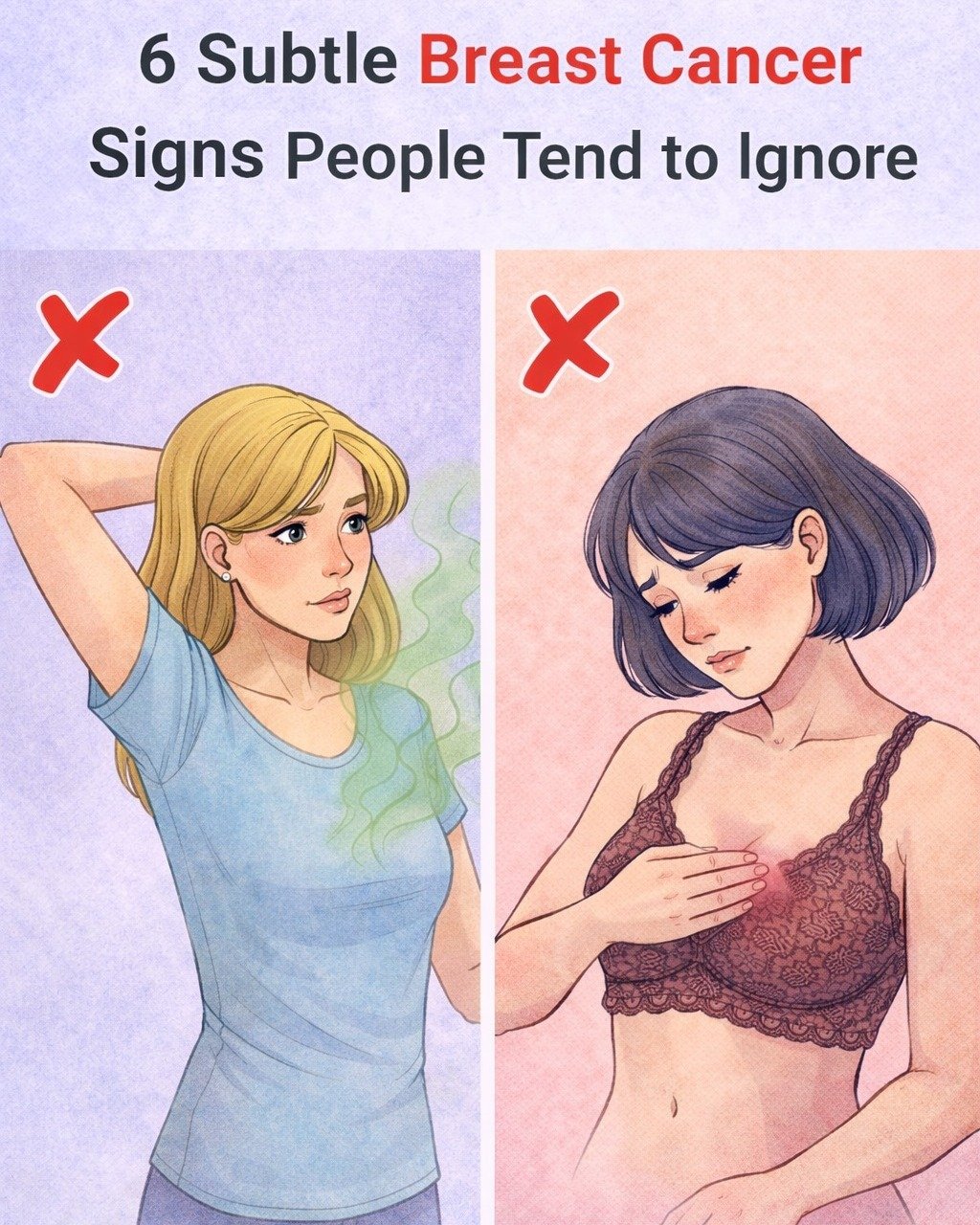
Breast cancer is often detected through screening before symptoms appear, but when changes do show up, they can be surprisingly easy to overlook or explain away as “normal,” “hormonal,” “aging,” or “nothing serious.” Early detection dramatically improves outcomes — many women who notice these subtle signs early and act quickly have excellent prognoses.
Here are 6 of the most commonly ignored yet frequently reported early warning signs of breast cancer (based on guidelines from the American Cancer Society, Breast Cancer.org, NHS, WHO, and large patient registries updated 2024–2025).
1. A New Lump or Thickening in the Breast or Underarm (Even If Painless)
Most lumps are benign, but any new, firm, hard, or irregular lump — especially one that doesn’t move easily or feels different from surrounding tissue — should be checked.
Why ignored: “It doesn’t hurt,” “probably a cyst,” “feels like normal breast tissue.”
2. Changes in Breast Shape, Size, or Contour
One breast suddenly looks larger, smaller, higher, lower, or asymmetrical in a way it wasn’t before — even without a clear lump.
Why ignored: “Weight gain/loss,” “hormones,” “bra doesn’t fit right.”

3. Skin Dimpling, Puckering, or Orange-Peel Texture
The skin over the breast develops small dents, ridges, or a texture like orange peel (peau d’orange) — often only visible when raising arms or pressing gently.
Why ignored: “Dry skin,” “stretch marks,” “just how my skin looks now.”
4. Nipple Changes (Inversion, Retraction, or Scaling)
A previously normal nipple suddenly turns inward (inversion), flattens, or develops scaling, crusting, or eczema-like changes.
Why ignored: “Always been like that,” “dry skin,” “irritation from bra.”
5. Nipple Discharge (Especially Spontaneous, Bloody, or Clear)
Fluid leaking from one or both nipples without squeezing — particularly if it’s bloody, clear/straw-colored, or only from one duct.
Why ignored: “Hormones,” “breastfeeding long ago,” “one-time thing.”
6. Persistent Breast or Nipple Pain (Not Related to Menstrual Cycle)
Aching, burning, stabbing, or tenderness in one area of the breast or nipple that lasts weeks and isn’t tied to your cycle.
Why ignored: “Muscle strain,” “bra too tight,” “hormonal fluctuations.”
Quick Urgency Guide – When to See a Doctor
Urgent (within days)

- New lump + skin dimpling/puckering + nipple retraction
- Spontaneous bloody/clear nipple discharge from one breast
- Persistent one-sided breast pain + any skin change
Prompt (1–2 weeks)
- Any 2–3 of the 6 signs lasting >2–4 weeks
- New asymmetry + thickening + no clear cause
Routine check (don’t wait for symptoms)
- Age 40+: annual mammogram (or biennial depending on risk/guidelines)
- High-risk (family history, BRCA mutation, dense breasts): earlier & more frequent screening (MRI + mammogram)
- Monthly breast self-awareness (not strict self-exam) — know what’s normal for you
Bottom Line
Breast cancer rarely starts with dramatic pain or large lumps. These 6 subtle signs are among the most consistent early warnings reported by women later diagnosed — and almost never appear all at once. When multiple signs persist >2–4 weeks — especially painless lump + skin changes + nipple discharge — they are never “normal.”
You know your breasts best. Trust persistent changes that feel different or worsening. A quick clinical breast exam + mammogram/ultrasound is simple, non-invasive, and can detect problems early — when treatment is most effective and often less invasive.
Action step tonight
Look in the mirror (arms raised and lowered) — check for asymmetry, dimpling, nipple changes. Gently feel for lumps/thickening.
Note any persistent signs from this list. If 2–3 feel familiar — schedule a doctor or mammogram appointment this month.
Disclaimer
This article is for informational purposes only and is not medical advice. Many of these signs have benign causes (cysts, fibroadenomas, hormonal changes, infection, etc.), but persistent or multiple symptoms require urgent evaluation. Never self-diagnose or delay care based on this list. Sudden severe breast pain, rapid changes, or any concerning symptom — seek medical attention immediately. Personalized assessment (clinical exam, mammogram, ultrasound, biopsy if indicated) by a breast specialist or gynecologist is essential. Early detection dramatically improves outcomes. Follow evidence-based breast cancer screening guidelines for your age and risk factors.