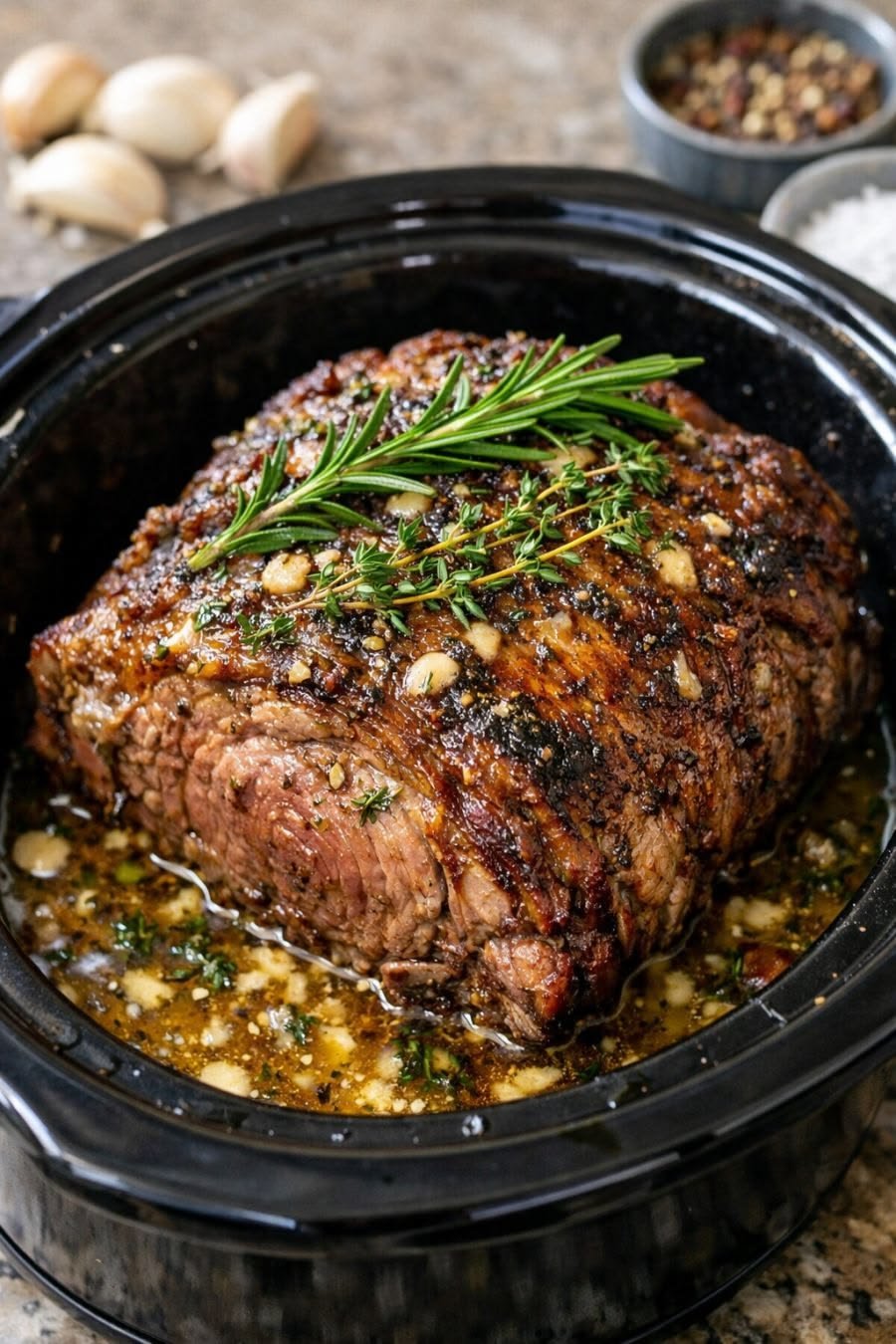
A tender, juicy prime rib roast cooked slowly with garlic, rosemary, thyme, and savory beef broth, then served with a rich homemade au jus for dipping.
This elegant roast is perfect for Christmas dinner, holiday gatherings, Sunday family meals, or any special occasion when you want a delicious beef roast without constantly watching the oven.
Important cooking note: Prime rib is a premium cut that is best served medium-rare to medium for tenderness. A slow cooker can cook it gently, but it will not develop a traditional browned crust on its own. Searing the roast before slow cooking and finishing it briefly under a hot broiler helps create that classic prime rib flavor.
Recipe Overview
Prep time
20 minutes
Cook time
4–6 hours
Total time
Approximately 5–7 hours
Servings
6–8
Difficulty: Medium
Cooking method: Slow cooker with optional oven finish
Ingredients
For the prime rib roast
4–5 pounds bone-in or boneless prime rib roast
2 tablespoons olive oil
2 tablespoons softened butter
5 cloves garlic, minced
1 tablespoon fresh rosemary, chopped
1 tablespoon fresh thyme leaves
2 teaspoons kosher salt
1 teaspoon freshly ground black pepper
1 teaspoon paprika
1 teaspoon onion powder
1 teaspoon Dijon mustard, optional
For the slow cooker
1 large onion, sliced
2 carrots, roughly chopped
2 celery stalks, roughly chopped
4 cloves garlic, smashed
1½ cups low-sodium beef broth
½ cup dry red wine, optional
1 tablespoon Worcestershire sauce
1 teaspoon soy sauce, optional
2 sprigs fresh rosemary
3 sprigs fresh thyme
1 bay leaf
For the au jus
Slow cooker cooking liquid
1–2 cups additional beef broth, as needed
1 teaspoon Worcestershire sauce, or to taste
½ teaspoon Dijon mustard, optional
Salt and black pepper, to taste
Optional thickener, if you prefer a slightly thicker sauce:
1 tablespoon cornstarch
1 tablespoon cold water
Traditional au jus is usually thin and savory rather than gravy-like, so thickening is optional.
Step-by-Step Instructions
Step 1: Prepare the roast
Remove the prime rib from the refrigerator approximately 30–45 minutes before cooking.
Pat the roast dry with paper towels. Drying the surface helps it brown more effectively.
If the roast has a thick fat cap, trim it slightly, leaving approximately ¼ inch of fat for flavor.
Step 2: Make the garlic-herb rub
In a small bowl, combine:
Softened butter
Olive oil
Minced garlic
Rosemary
Thyme
Salt
Black pepper
Paprika
Onion powder
Dijon mustard, if using
Mix until a thick herb paste forms.
Rub the mixture generously over the entire roast, including the sides.
Step 3: Sear the prime rib
Heat a large skillet over medium-high heat.
Add a little oil if needed.
Place the roast in the skillet and sear for approximately 2–4 minutes on each side, including the ends.
The outside should develop a deep golden-brown crust.
Searing adds flavor and improves the final appearance, although it does not seal in the juices.
Step 4: Prepare the slow cooker
Place the sliced onion, carrots, celery, and smashed garlic in the bottom of the slow cooker.
These vegetables create a flavorful base for the cooking liquid and au jus.
Add the beef broth, red wine if using, Worcestershire sauce, soy sauce if using, rosemary, thyme, and bay leaf.
Stir gently to combine.
Step 5: Add the roast
Place the seared prime rib on top of the vegetables.
For a bone-in roast, position it bone-side down if that allows it to sit securely.
The roast should fit comfortably inside the slow cooker with the lid closed.
The liquid should come only partway up the sides of the roast, not completely cover it.
Step 6: Slow cook
Cover the slow cooker with its lid.
Cook on LOW for approximately 4–6 hours, depending on the roast’s size, shape, and your slow cooker.
Begin checking the internal temperature well before the estimated cooking time is finished.
Avoid repeatedly opening the lid because it releases heat and extends the cooking time.
Do not rely on cooking time alone. Prime rib is best cooked using a reliable meat thermometer.
Step 7: Check the internal temperature
Insert a meat thermometer into the thickest part of the roast, avoiding bone and large pockets of fat.
For a tender prime rib, many cooks remove the roast before its final serving temperature because it continues to rise while resting.
| Desired doneness | Approximate temperature to remove |
|---|---|
| Rare | 115–120°F |
| Medium-rare | 120–125°F |
| Medium | 130–135°F |
| Medium-well | 140–145°F |
These are culinary pull-temperature targets, not guaranteed food-safety temperatures. For food safety, USDA guidance recommends whole beef roasts reach at least 145°F (63°C), followed by a 3-minute rest. Use the safe minimum when serving children, older adults, pregnant people, or anyone at increased risk from foodborne illness.
Step 8: Rest the roast
Carefully remove the roast from the slow cooker and place it on a cutting board.
Tent loosely with foil and allow it to rest for approximately 20–30 minutes.
Resting helps the juices redistribute and makes the roast easier to slice.
Step 9: Make the au jus
While the roast rests, carefully pour the slow cooker liquid through a fine-mesh strainer into a saucepan.
Discard the cooked vegetables and herbs, or reserve the carrots for serving.
Skim excess fat from the surface of the liquid.
Bring the strained liquid to a gentle simmer over medium heat.
Add additional beef broth if needed to make enough au jus for serving.
Stir in Worcestershire sauce and Dijon mustard, if using.
Taste and adjust with salt and black pepper.
Simmer for 5–10 minutes to concentrate the flavor.
Step 10: Optional oven finish
For a more traditional prime rib crust, preheat the oven broiler.
Place the rested roast on a broiler-safe pan and broil briefly, watching closely, until the exterior becomes browned and crisp.
This step is optional and should be done carefully to avoid overcooking the roast.
Step 11: Slice and serve
Remove any butcher’s twine.
Slice the prime rib against the grain into thick or thin slices, depending on your preference.
Arrange the slices on a warm serving platter.
Pour a little au jus over the meat or serve the sauce in a separate bowl for dipping.
Taste and Texture
Prime rib: Tender, juicy, and rich with beef flavor.
Garlic and herbs: Add a fragrant, savory crust.
Slow cooker liquid: Creates a deep, beefy flavor.
Au jus: Thin, savory, and perfect for dipping.
Optional broiler finish: Adds a browned exterior and more traditional roast flavor.
Helpful Tips for Perfect Prime Rib
Choose the right roast
A rib roast with good marbling will generally produce a more flavorful and tender result.
Sear before slow cooking
Searing creates browned flavor compounds that enhance the roast and the au jus.
Use a thermometer
Prime rib is expensive, and a thermometer is the best way to avoid overcooking it.
Avoid cooking on HIGH
LOW generally provides more gentle cooking and better control for a premium roast.
Do not add too much liquid
Prime rib does not need to be submerged. Too much liquid can make the exterior more like a braised roast than a traditional prime rib.
Rest before slicing
Allowing the roast to rest helps keep the slices juicy.
Delicious Variations
Garlic Butter Prime Rib
Add extra softened butter and garlic to the herb rub for a richer flavor.
Rosemary Dijon Prime Rib
Increase the Dijon mustard and rosemary for a sharper, herbaceous flavor.
Red Wine Au Jus
Add dry red wine to the slow cooker liquid and simmer the strained liquid to create a deeper, more complex sauce.
Pepper-Crusted Prime Rib
Add extra cracked black pepper to the rub for a bold, steakhouse-style flavor.
What to Serve With Prime Rib
This roast pairs beautifully with:
Creamy mashed potatoes
Roasted potatoes, carrots, and green beans
Yorkshire pudding
Creamed spinach
Garlic roasted Brussels sprouts
Dinner rolls
Horseradish sauce
Classic Caesar salad
Storage and Reheating
Refrigerator
Store leftover prime rib in an airtight container for 3–4 days.
Keep the au jus separately so the meat can be reheated gently.
Reheating
Place sliced prime rib in a covered baking dish with a little au jus or beef broth.
Warm in a 250°F (120°C) oven until heated through.
Avoid high heat because it can quickly make the meat dry and tough.
Freezing
Freeze cooled slices in airtight freezer-safe containers or bags with a little au jus.
For best quality, use within 2–3 months.
Thaw in the refrigerator before reheating.
Approximate Nutrition
Per serving, assuming 8 servings and excluding optional sides:
| Nutrient | Approximate amount |
|---|---|
| Calories | 450–600 |
| Protein | 35–45 g |
| Fat | 30–45 g |
| Carbohydrates | 2–5 g |
| Fiber | 0–1 g |
| Sugar | 1–2 g |
Nutrition varies significantly depending on the cut, portion size, fat trimming, and whether the roast is bone-in or boneless.
Frequently Asked Questions
1. Can I cook prime rib entirely in a slow cooker?
Yes. You can cook it entirely in the slow cooker, although the exterior will not develop the same crust as an oven-roasted prime rib unless you sear or broil it.
2. Should the prime rib be covered with broth?
No. Add enough broth to create flavorful cooking liquid, but do not completely submerge the roast.
3. Can I use a frozen prime rib?
No. Thaw the roast completely in the refrigerator before slow cooking. Cooking a large frozen roast in a slow cooker can keep it at unsafe temperatures for too long.
4. Can I make the au jus ahead of time?
Yes. Prepare the au jus up to 2 days ahead and refrigerate it. Reheat gently before serving.
5. Why did my prime rib become tough?
It may have been overcooked, sliced with the grain, or cooked in a way that did not suit the cut. Prime rib is a tender roast and generally does not need the long cooking time used for tougher cuts such as chuck roast.
6. Can I use boneless prime rib?
Yes. Boneless prime rib works well and is often easier to fit into a slow cooker. Cooking time will depend on its thickness and weight.
7. Is the au jus the same as gravy?
No. Au jus is a thin, savory beef sauce made from the roast’s cooking juices. Gravy is usually thickened with flour or cornstarch.
Chef’s Tips
Use a roast that fits comfortably in the slow cooker.
Pat the meat dry before seasoning.
Sear all sides for the best flavor.
Use fresh rosemary and thyme when available.
Keep the lid closed during cooking.
Check temperature early rather than waiting until the end of the estimated cooking time.
Rest the roast before slicing.
Strain and skim the au jus for a cleaner, richer sauce.
Slice against the grain for the most tender bites.
Final Result
Slow Cooker Prime Rib Roast with Au Jus is a flavorful, elegant beef dinner with garlic-herb seasoning, tender slices of prime rib, and a rich savory dipping sauce. With careful temperature monitoring, a good sear, and a proper resting period, you can create a memorable holiday or special-occasion meal right in your slow cooker.